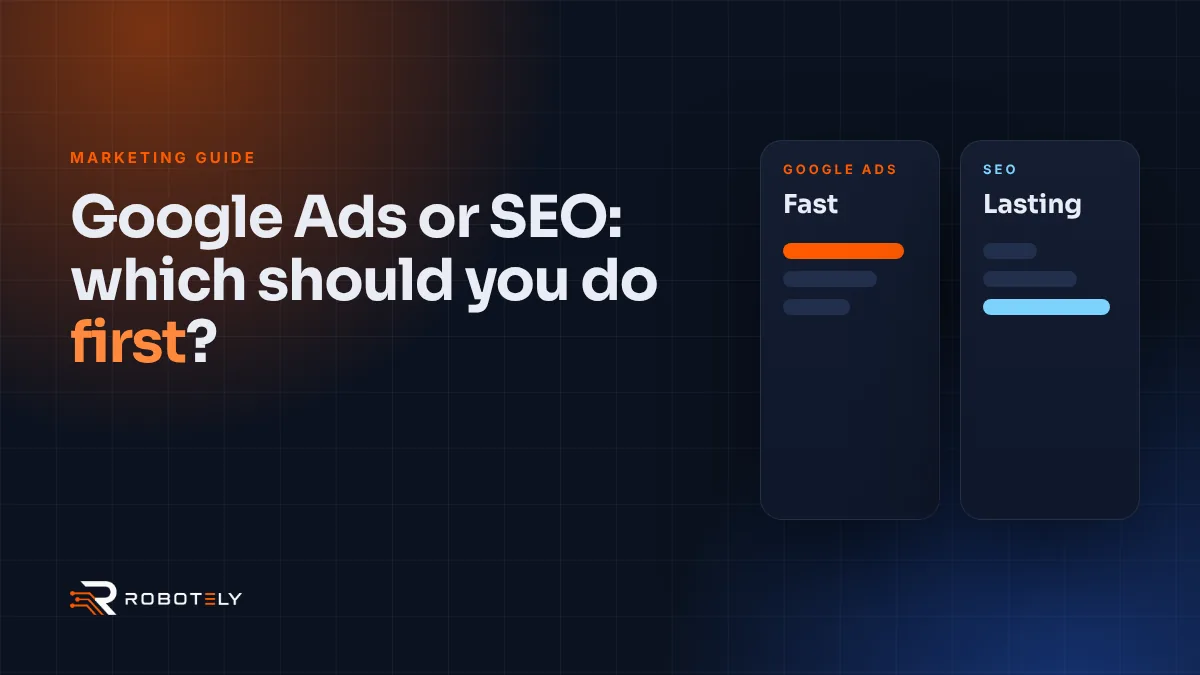
Short answer: start with Google Ads if you need enquiries quickly and have a budget for clicks. Start with SEO if you can wait a few months and want customers from Google without paying for every visit. Many local businesses do both: ads for quick wins while SEO builds up.
What is the difference between Google Ads and SEO?
Google Ads are paid listings. You choose the searches you want to appear for, and you pay when someone clicks. SEO (search engine optimisation) is the work that helps your website and Google Business Profile appear in the free results and on Google Maps.
| Google Ads | SEO | |
|---|---|---|
| How fast? | Ads can show as soon as the campaign is approved | Usually takes months to build |
| Cost model | You pay per click, plus management | Monthly work, no cost per click |
| When you stop | Visits stop when the ads stop | Rankings can keep bringing visits |
| Control | Choose exact searches, areas and times | Google decides rankings |
| Best for | Urgent services, new businesses, offers | Long-term, steady enquiries |
When should you start with Google Ads?
- You need enquiries this month, not in six months.
- You offer urgent services, such as emergency repairs.
- You’re a new business with no rankings yet.
- You want to test which services and areas bring the best jobs.
Learn how Google Ads works in Google’s Ads Help Centre, or see how we manage Google Ads.
Not sure whether to start with Google Ads or SEO?
Tell us about your business and we’ll recommend the right mix for your budget, with a free, no-obligation quote.
Get free advice →See our Google Ads service
When should you start with SEO?
- You can wait a few months for results.
- You want enquiries without paying for every click.
- Your competitors already rank and you want to catch up.
- You want to show up in AI answers, such as Google’s AI Overviews, which usually draw on pages that already rank well.
Google’s SEO Starter Guide explains the basics. Our local SEO service covers your website, Google Business Profile and reviews.
Can you do both?
Yes, and for many local businesses it’s the best plan. Ads bring calls while SEO builds up. Over time, as your free rankings grow, you can spend less on ads for the searches you already rank for.
How much does Google Ads cost in the UK?
You pay for each click, so your cost depends on how competitive your trade is. Whito’s UK PPC cost research (Q1 2026 data, described as indicative estimates) puts most UK small businesses at about £1.50–£2.50 per click, and local trades at about £1.50–£3.00.
| Industry | Average cost per click (UK) | Typical range |
|---|---|---|
| Home services | £3.20 | £1.50–£5.50 |
| Healthcare and dental | £2.80 | £1.50–£5.00 |
| Legal services | £8.25 | £4.50–£15.00+ |
| Retail and ecommerce | £0.95 | £0.40–£2.00 |
The same research suggests £500–£1,000 a month is a sensible test budget for most local businesses. If someone manages the ads for you, add a management fee on top: roughly £200–£800 a month for a freelancer or £500–£1,500 for a small-budget agency. For trade-specific figures, read how much Google Ads cost for UK tradesmen.
How much does SEO cost?
SEO is usually a monthly fee for the work, with no cost per click. For a local business, that covers your website pages, Google Business Profile, reviews and local listings. Most UK small-business retainers start from a few hundred pounds a month and rise with competition and the number of areas you want to rank in. Our guide to SEO packages in the UK explains what should be included at each level.
Worked example: cost per enquiry
Here is a simple comparison using example figures. Your own numbers will differ, but the method works for any business.
| Google Ads | SEO | |
|---|---|---|
| Monthly spend | £1,000 on clicks + £300 management | £500 a month |
| What you get | About 400 clicks at £2.50 each | Rankings that build over 3–6 months |
| Enquiries (if 5% of visitors get in touch) | About 20 a month, from month one | Say 20 a month by month six, and growing |
| Cost per enquiry | About £65 | About £25 once rankings are in place |
| If you stop paying | Enquiries stop the same day | Rankings fade slowly over months |
Ads win on speed. SEO usually wins on cost per enquiry over the long run. That is why many local businesses run both at first, then shift budget towards SEO as their free rankings grow.
When Google Ads is the better choice
- You need calls this month. Ads can start bringing in enquiries as soon as the campaign is approved.
- You offer urgent services. People searching “emergency electrician near me” call one of the first results they see, and ads sit at the top.
- You want to test a new service or area. Ads show quickly whether people search for it and whether they convert.
- You have a time-limited offer. Turn ads on for the offer, then off again.
When SEO is the better choice
- You want leads without paying per click. Once you rank, each extra visit costs nothing.
- Your customers research first. For bigger jobs like extensions or new roofs, people read reviews and guides before calling.
- You want to show up in AI answers. Google’s AI Overviews and ChatGPT draw on websites and reviews, not on ads. See Google AI Overviews for local businesses.
- You are building a business to last. Rankings, reviews and a strong website keep working even in months when you can’t spend on ads.
How to measure which one is working
Whichever you choose, judge it by enquiries and jobs, not by clicks or rankings alone. Each month, track:
- Cost per enquiry: total spend divided by calls and form enquiries.
- Cost per job won: spend divided by enquiries that turned into paid work.
- Where enquiries came from: ads, Google Maps, the normal results or referrals. Ask every new customer how they found you.
- Value of jobs won: a channel that brings fewer but bigger jobs may be worth more.
Review the numbers every three months. If ads cost more per job than SEO, start moving budget across. If SEO is slow in a competitive area, ads can fill the gap while it builds.
Which should you start with? A quick guide
| Your situation | Best place to start |
|---|---|
| New business with no reviews yet | Google Ads, plus a Google Business Profile from day one |
| Emergency or urgent services (locksmith, drainage, boiler repair) | Google Ads or Local Services Ads, with SEO alongside |
| Seasonal work, such as landscaping or roofing before winter | Google Ads for the busy season, SEO for the rest of the year |
| Tight budget (under about £500 a month) | SEO and your Google Business Profile |
| Established business with good reviews | SEO first, with ads for your most profitable services |
Common mistakes with Google Ads and SEO
- Sending ad clicks to your homepage. Send them to the page for the exact service they searched.
- Using broad keywords. Without negative keywords, you pay for searches like “plumber jobs” or “DIY boiler repair”.
- Not tracking calls. If you can’t see which clicks became calls, you can’t tell what works.
- Stopping SEO after two months. Local SEO usually takes 3–6 months to show its full value.
- Ignoring your Google Business Profile. For local searches, the map results often get more calls than either ads or the normal results. See how to get your business on Google Maps.
FAQs
How much should a small business spend on Google Ads each month?
For most local businesses, £500–£1,000 a month in ad spend is enough to test whether Google Ads works, before management fees. Competitive trades in big cities may need more.
Does paying for Google Ads improve my SEO?
No. Paying for ads doesn’t change your free rankings or your position on Google Maps. The two work separately, although ad data can show which searches bring in customers.
Is SEO cheaper than Google Ads?
Over the long term SEO often costs less per enquiry, because you don’t pay for each click. In the short term, Google Ads is the faster way to get calls.
How long does SEO take?
Most local businesses see changes within a few months. It depends on your competition and the state of your website.
Do I need a website for Google Ads?
You need a page for visitors to land on, and it should make it easy to call or ask for a quote. Read what a website costs in the UK.
Not sure which is right for you?
Tell us about your business and we’ll recommend the best place to start. Get a free quote.